Streamlining Your Creative Workflow with the 4 Sizes Fridge Magnet Templates Bundle
In the world of custom merchandise and small-batch production, efficiency is the bridge between a fleeting idea and a tangible product. For creators working with physical items like fridge magnets, the journey from concept to finished piece is often bogged down by technical setup, sizing inconsistencies, and file compatibility issues. The 4 Sizes Fridge Magnet Templates Bundle is designed to remove these friction points, providing a structured starting point that integrates directly into established design and production workflows. This resource is not about doing the creative work for you, but about ensuring the technical foundation is solid so your creativity can proceed without unnecessary interruption.
Understanding the Bundle's Role in Your Process
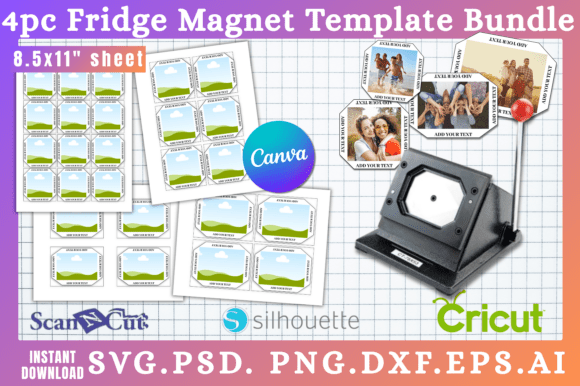
At its core, this bundle is a set of pre-configured, scalable vector templates for fridge magnets in four common sizes. It serves as the foundational layer in a multi-stage process that typically involves design ideation, file preparation, cutting, assembly, and quality control. By offering templates in SVG, PSD, PNG, DXF, PDF, and via a Canva link, it speaks directly to the diverse software ecosystems creators already use. This compatibility is key; it means the templates are not an isolated asset but a connector piece, designed to slot into workflows centered around Cricut Design Space, Silhouette Studio, Adobe Photoshop, Canva, and other vector-based editors.
The true value emerges when you consider the alternative. Starting from a blank canvas in your cutting software means manually setting up artboards, defining cut lines, and ensuring each size variant is correctly proportioned. This process is prone to error and repetition. The bundle acts as a pre-production safeguard, ensuring that every design you create from this point forward is built on a correct, print-and-cut-ready foundation. It shifts your focus from technical configuration to design execution.
Practical Integration: Before, During, and After Design
The bundle finds its place at different points in the workflow, depending on your project's nature. For a product-based business launching a new magnet line, you would use the templates before design even begins. You'd download the files, open the sizes in your software of choice, and use them to establish safe zones, bleed areas, and cut paths. This initial setup ensures that every subsequent design in the series will be consistent and production-ready, saving hours of per-item adjustment later.
For a freelance designer or hobbyist working on a one-off custom gift, the templates are used during the design phase. You might select the Canva link for quick ideation, dragging and dropping your graphics onto the pre-sized canvas. This allows for rapid prototyping and client approvals. Once the concept is locked, you can move to a more robust tool like Adobe Illustrator or Photoshop using the SVG or PSD files for final refinement and high-resolution output.
After the design is complete, the templates ensure a smooth transition to production. The SVG and DXF files contain the precise path data needed by cutting machines like Cricut or Silhouette. You can import the file directly into the machine's software, and the cut lines are already defined by the template. This eliminates the most common technical headache in the process: manually tracing your design to create a cut path. The result is a cleaner, more efficient production run with less material waste from misaligned cuts.
Key Workflow Considerations and Implementation Tips
To maximize the utility of the bundle, consider these practical aspects of integration:
- Software Selection & File Management: Choose the file format that best matches your primary design tool to start. If you use Canva for initial mockups but Silhouette Studio for cutting, plan your workflow accordingly. Download all formats and organize them in a project folder. A consistent naming convention (e.g., "Magnet_Template_3in_SVG.svg") prevents confusion when you have multiple projects.
- Layer Management in PSD/AI: When opening the PSD or SVG files, take a moment to examine the layer structure. Well-organized templates will have separate layers for the design area, bleed zone, and cut line. Lock the template layers before you begin designing on new layers above them. This protects the foundational structure and makes final file cleanup for production straightforward.
- Leveraging the Canva Link for Collaboration: The Canva template is particularly useful for brainstorming sessions or client feedback. Share the link directly with a client or team member, allowing them to suggest edits or place placeholder graphics in real-time. This collaborative step can happen before any technical work begins in advanced software, aligning everyone on the vision early.
- Ensuring Cut Path Integrity: Before sending a file to your cutting machine, always perform a test cut on scrap material. Use the template's defined cut line as your guide. If the cut is slightly off, you may need to adjust the offset in your machine's software—a one-time calibration that the template makes possible by providing a perfect baseline shape.
- Scalability and Batch Processing: Because the bundle includes four sizes, it supports product line diversification. Design a core graphic once, then quickly adapt it to the other template sizes. This is efficient for creating product sets or testing market response to different dimensions. The vector formats (SVG, DXF) ensure that scaling up or down does not degrade quality.
Long-Term Use and Quality Control
Treating the templates as a reusable asset rather than a one-time download transforms them into a cornerstone of your production system. Over time, you build a library of designs all built on the same reliable foundation. This consistency is crucial for brand identity and customer expectations, especially for small business owners. A magnet purchased in January should be identical in shape and cut quality to one purchased in December.
Furthermore, the bundle supports quality control at the file level. By standardizing your starting point, you reduce variables. If a production issue arises, you can more easily diagnose whether it stems from the design file, the cutting machine, or the material—because the template's integrity is a known constant. This systematic approach is what separates casual crafting from scalable, professional output.
Ultimately, the 4 Sizes Fridge Magnet Templates Bundle is about process optimization. It addresses the technical prerequisites of a physical product workflow, allowing you to dedicate your mental energy to the creative and strategic aspects of your project. Whether you are an educator creating classroom rewards, a marketer producing branded giveaways, or an entrepreneur building a product line, integrating these templates means your workflow begins with a solution, not a problem to solve. It’s a practical step toward a more efficient, consistent, and professional creative practice.